Contested RF world demands new approach to UAS trust, USSOCOM official says
NewsMay 18, 2026
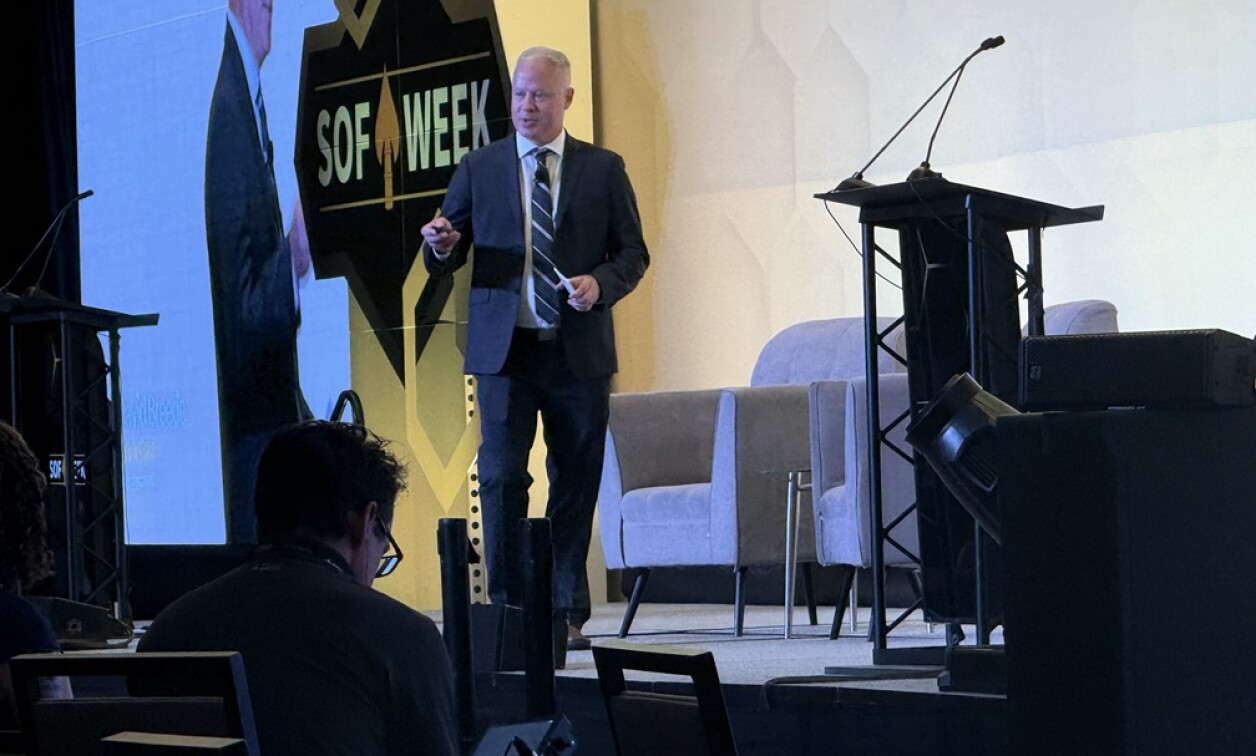
TAMPA, Florida. Learning how to operate in a radio frequency (RF) environment that is heavily contested is one of the chief challenges facing U.S. Special Operations Command (USSOCOM), and figuring out autonomous trust will be key to that effort, said David Breede, Deputy Director for Acquisition at USSOCOM, during his keynote at SOF Week 2026.
"It's all about that contested RF environment," Breede said. "How do I operate completely untethered to RF? How are we operating either fully autonomously, or operators forward deployed but not connected in the rear?"
The challenge, he said, is not purely technical -- it is also psychological and institutional. He added that decades of doctrine built on persistent uplinks to GPS, satellite communications, and higher headquarters have created a dependency that will be hard to break.
"What we built up over the last 20 years was this dependence upon full connection with higher headquarters," he said. "When we push something out as full autonomy, you have to be able to trust that they're going to go through their mission, even when you can't see them do their mission, and then come back and tell you how that mission went."
When asked what technology USSOCOM needs most urgently, Breede pointed to the lack of platform-agnostic autonomous capabilities -- specifically, the ability to drop a capability like automated target recognition onto dissimilar platforms across domains and have them interoperate.
"The ability to quickly integrate autonomous behaviors on multiple platforms, in multiple domains, without it having to be specifically built for that platform -- that's something I'd like to see move faster," he said.
The problem is that vendors may offer capable collaborative autonomy solutions, but only within their own algorithm stack, leaving a group one UAS and an unmanned surface vessel unable to share targeting algorithms or fused environmental data unless purpose-built to the same architecture. "I think we're still moving very slowly in that area," he said.
Breede also outlined how USSOCOM's acquisition structure enables rapid fielding. He cited three structural advantages: scale (USSOCOM isn't building aircraft carriers, enabling program managers to accept risk levels larger programs cannot); delegated authority (roughly 95% of programs have milestone decision authority at the O-6 level); and geography (the entire acquisition enterprise is co-located in Tampa, enabling same-day decisions).
He pushed back on the idea that DoD acquisition is inherently broken. "Give me money and requirements, and the tools we have allow us to go pretty much as fast as we need," he said.
For vendors seeking to engage, Breede pointed to USSOCOM's Vulcan platform -- which has more than 25,000 registered companies -- as a primary on-ramp, along with technical experimentation events scheduled for August and September.