The fastest growing part of the SOF Week exhibits floor over the last few years has been companies focused on autonomous systems – air, ground, and sea – many carrying artificial intelligence (AI) solutions. The 2026 event, for which we are again the Official Show Daily and Show Guide producer and where this issue is distributed, promises even more growth in these areas.

Military Embedded Systems
Op-Eds
Unmanned
From The Editor

GIVING BACK: Word of Honor Fund - Blog
May 06, 2026Each issue, the editorial staff of Military Embedded Systems will highlight a different organization that benefits the military, veterans, and their families. We are honored to cover the technology that protects those who protect us every day.
Comms

GUEST BLOG: Space resilience is critical. So why are satellites still so exposed? - Blog
April 28, 2026Only recently, Iran jammed satellite internet signals to restrict access inside its own borders, while Russia has constantly interfered with satellite broadcasts that support Ukraine – these are just some of the more visible demonstrations of the fact that space systems can be disrupted and that they are considered targets in modern conflict.
Avionics

GUEST BLOG: The convergence of safety and security -- Five steps to building modern avionics software - Blog
April 28, 2026In the early days of avionics, software operated in silos, or isolated computing environments with little to no outside connectivity. Today, modern airborne systems are increasingly linked to maintenance systems, passenger networks, and cloud-based analytics.
Unmanned

GUEST BLOG: Closing the gap -- Propulsion requirements for next-generation counter-UAS interceptors - Blog
March 11, 2026Russia's use of low-cost Shahed and Geran drones in Ukraine has exposed a gap in Western defense. NATO and allied forces have no efficient counter to cheap, high-volume aerial threats. Each swarm attack forces defenders to use interceptors that cost hundreds of times more than the incoming drones. Stockpiles deplete and production cannot keep up. Current propulsion systems are either too expensive, too slow to manufacture, or lack the performance to complete the mission. The solution requires propulsion systems that deliver performance and reliability at a price point and production scale that matches the threat. Turbojet engines with start times less than 20 seconds, speeds as fast as 0.9 Mach, and proven manufacturability enable a path forward.
Cyber

GUEST BLOG: Making the most of the transition to IPv6 - Blog
March 11, 2026There’s a major technology evolution happening that impacts everyone’s internet access – but no one is talking about it. It’s not AI or an emerging cyber threat, but the transition to the most recent version of the Internet Protocol (IP), IPv6.
Unmanned

GUEST BLOG: Military vehicle design in the age of drone warfare - Blog
March 11, 2026Modern light military vehicles were originally engineered with off-road mobility and protection against ground-based threats as their primary purpose. As the war in Ukraine has demonstrated, however, the battlefield is rapidly changing.
Avionics

GUEST BLOG: Continuous delivery, continuous advantage -- Rethinking defense software for the embedded era - Blog
March 11, 2026Software decides future wars. Every aircraft, tank, and communications system runs on embedded software. From targeting to telemetry, code defines capability and determines who wins. Once deployed to production, the software on those systems is open to adversaries’ exploitation. There is no safe harbor. Delay a patch by months, and you haven’t just slipped schedule – you’ve left the warfighter defenseless.
A.I.

GUEST BLOG: Modernizing mission compute -- Enabling AI through modular GPU expansion - Blog
March 10, 2026As embedded systems continue to demand higher performance for data-intensive workloads, system designers are under increasing pressure to add compute capability without redesigning the entire platform. Many deployed mission systems were designed at a time when deterministic signal processing and traditional image fusion dominated requirements. While those architectures continue to perform well for legacy workloads, they struggle to support today’s artificial intelligence (AI)-driven classification, perception, and decision-support algorithms at operational tempo. XMC [switched mezzanine card] modules can offer a proven, modular approach for scaling compute performance while preserving system flexibility, size, and life cycle stability.
A.I.

GUEST BLOG: The DoD must emulate Ukraine’s iterative edge - Blog
March 10, 2026By now, “Ukraine success = UAVs + AI” [artificial intelligence] is not only a meme to American warfighting planners and U.S. Department of Defense (DoD) leadership, it’s the principal catalyst for how the U.S. military wants to speed up program and product development.
Unmanned

GUEST BLOG: New year predictions for the ability of defense organizations to sustain mission readiness - Blog
March 10, 2026Defense logistics need a strategic upgrade – from localized 3D printing on the front line to counter-drone defense and expanding defense manufacturing to integrating artificial intelligence (AI) beyond the battlefield.
Radar/EW

GUEST BLOG: The SOSA Technical Standard – a game-changer for both the industry and the warfighter - Blog
March 10, 2026The SOSA Technical Standard is just that, a technical standard, written by technical people for a technical audience.
From The Editor

GIVING BACK: The Frontline Healing Foundation - Blog
March 02, 2026Each issue, the editorial staff of Military Embedded Systems will highlight a different organization that benefits the military, veterans, and their families. We are honored to cover the technology that protects those who protect us every day.
Unmanned
Reduced SWaP pressure forcing connector redesigns - Blog
February 26, 2026Most defense electronics programs don’t fail because the processor is too slow or the sensor isn’t accurate enough. They fail when the system can’t be packaged, powered, cooled, routed, and serviced inside the real-world envelope it has to live in. When that happens, the interconnect and wireharness is often where the physics shows up first.
From The Editor

GIVING BACK: Yellow Ribbon Fund - Blog
February 06, 2026Each issue, the editorial staff of Military Embedded Systems will highlight a different organization that benefits the military, veterans, and their families. We are honored to cover the technology that protects those who protect us every day.

-
KC-46 tanker upgrades to be accelerated by U.S. Air Force, Boeing
May 13, 2026
-
Night vision goggles to be supplied to U.S. Army by Elbit America
May 12, 2026
-
Advanced T-7A Red Hawk jet trainer cleared for production by U.S. Air Force
May 08, 2026
-
Closing the adoption gap in MOSA-driven avionics modernization
May 07, 2026
Unmanned
-
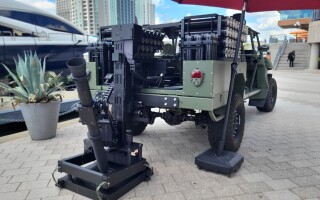
Special Operations and drone tech
May 19, 2026
-
SNC and Fairlead partner to produce AEGIR uncrewed surface vessels
May 19, 2026
-
AFSOC unveils 'Havoc Spear' cruise missile at SOF Week
May 19, 2026
-
BlackSea Technologies brings Comet unmanned surface vessel to SOF Week
May 19, 2026

-
SOF Week panel on lethal AI and autonomous systems headlined by Pentagon CTO Emil Michael
May 18, 2026
-
Middle East conflicts drive surge in demand for autonomous targeting systems
May 18, 2026
-
PODCAST: Leveraging AI for software mobility at the edge (video)
May 18, 2026
-
PODCAST: Gaining a cognitive advantage for Special Forces operations via AI (video)
May 16, 2026

-
Anduril and Booz Allen will join forces to increase security, lethality for SOF teams
May 19, 2026
-
PODCAST: Enabling network security in hostile environments (video)
May 18, 2026
-
WCore: Transforming appliances into software-defined modems
May 18, 2026
-
Continuous monitoring system for coalition tactical networks launched by Curtiss-Wright
April 21, 2026